TRAINING

Home / Training /

Event

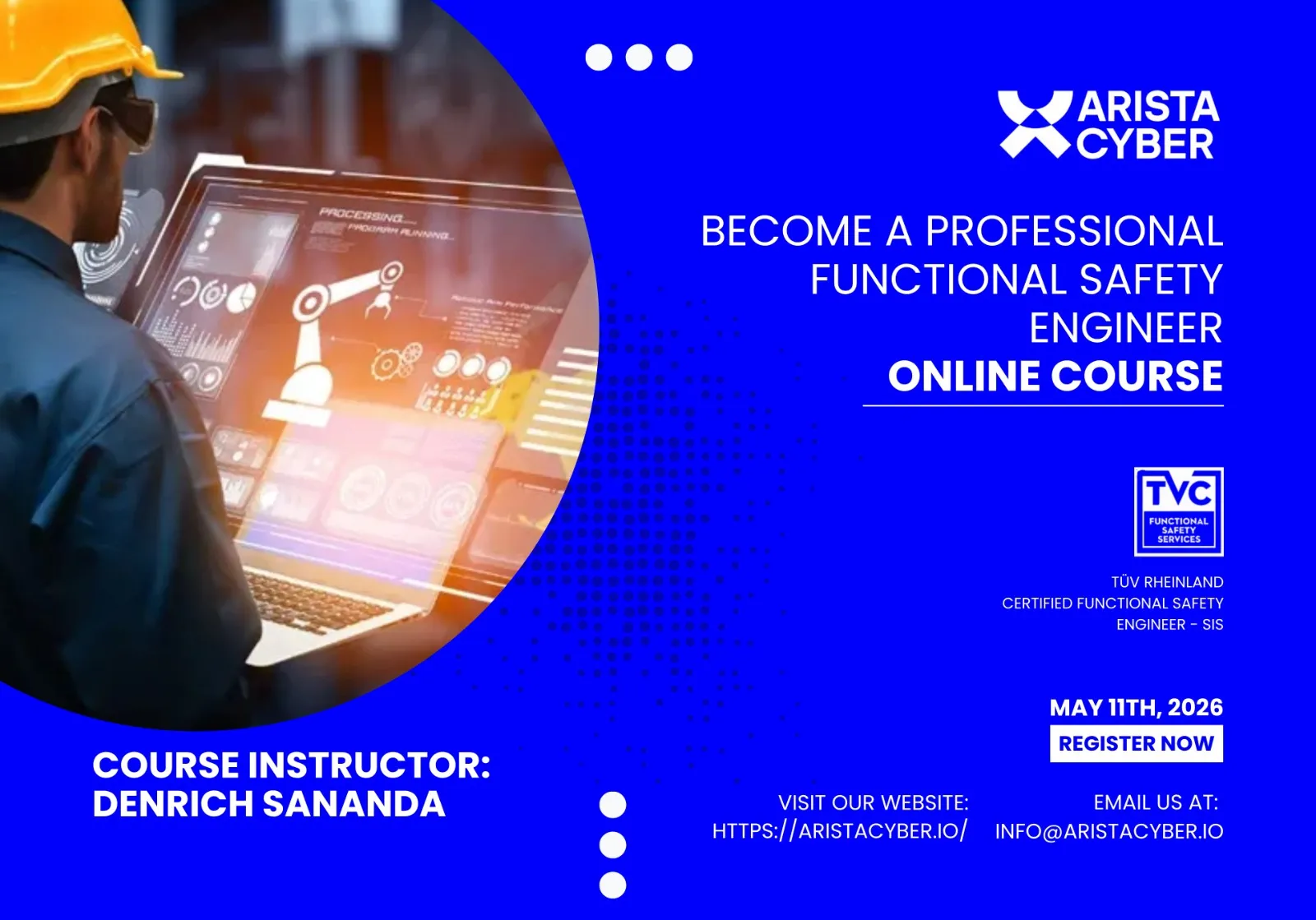
Functional Safety Engineer (TÜV Rheinland) for SIS Training

Earn your TÜV Rheinland Functional Safety Engineer certification. A rigorous, internationally recognised programme built on IEC 61508 and IEC 61511, designed for engineers working across the safety instrumented system lifecycle.


COURSE AT A GLANCE 


Format

Online

Duration

3 days training + 1 day self-study + exam on Day 5

Exam Duration

4 hours

Language

English

Participants

Maximum 12 per cohort

Certification

FS Engineer (TÜV Rheinland) — listed on TÜV Rheinland website

Organised by

Arista Cyber in partnership with TVC Functional Safety Services FZ-LLC

Contact

info@aristacyber.io  |  denrich@aristacyber.io


SECTION: ABOUT THE COURSE

About the Course

This TÜV Rheinland-accredited programme is designed for engineers involved in the design, operation, assessment, or management of Safety Instrumented Systems. It provides the foundational and advanced knowledge required to work competently across the full SIS lifecycle, grounded in IEC 61508 and IEC 61511 — the leading international functional safety standards.

The course was designed by Tino Vande Capelle, a globally recognised Functional Safety Expert and TÜV Rheinland Senior FS Expert (ID 109/05) who has been delivering this training since 2005. At Arista Cyber, the course is conducted by Denrich Sananda, a TÜV Rheinland certified FS Engineer (855/07) and FS Trainer (77/22) with more than 24 years of experience in the process industry, under the direct supervision of Tino Vande Capelle.

On successful completion of the exam, participants receive a personal TÜV Rheinland FS Engineer certificate and are listed on the TÜV Rheinland website — a globally recognised credential that demonstrates verified functional safety competency to clients, employers, and peers.


SECTION: WHY ATTEND

Why You Should Attend

IEC 61511 Edition 2.0, released in February 2016, sets a clear normative requirement for competency in the SIS lifecycle:

  • Anyone involved in safety lifecycle activities shall be competent to carry out the activities for which they are accountable
  • A procedure shall be in place to manage the competency of all persons involved in the SIS lifecycle
  • A periodic assessment shall be carried out to document the competency of individuals against the activities they are performing, and on any change of role


This course gives you the structured knowledge, practical understanding, and formally recognised certification to meet that requirement. Whether you are an engineer, safety professional, or technical manager, completing this programme demonstrates your functional safety competency with credentials that carry weight across the global process industry.

Beyond compliance, certification adds tangible value to your professional profile. The TÜV Rheinland FS Engineer designation is recognised by clients, project teams, and employers as a credible, independently verified measure of functional safety knowledge and capability.


SECTION: PREREQUISITES

Prerequisites

In accordance with the FS Engineer (TÜV Rheinland) programme requirements, applicants must meet the following criteria:

  • Minimum 3 years of experience in the field of functional safety
  • University degree (Master's or Bachelor's in Engineering) or equivalent engineering-level responsibilities confirmed by the employer in a signed statement letter


Eligibility Requirements forms must be completed, signed, and supported by the required documentation prior to the exam. Incomplete eligibility submissions will not be accepted.


SECTION: TRAINING PROGRAMME

Training Programme

The programme covers the complete IEC 61508 and IEC 61511 safety lifecycle, combining theoretical instruction with practical student exercises throughout.


Introduction to Functional Safety

  • Modern history of industrial disasters
  • What is safety? Legal status of IEC 61511
  • Overview of legal requirements and layers of protection
  • Safety Instrumented Systems and Safety Integrity Levels
  • Problems with safety systems and safety system failures
  • What is Functional Safety? Functional Safety Standards overview


Management of Functional Safety

  • Lifecycle concepts IEC 61508 and IEC 61511
  • Functional Safety Management and competency requirements
  • Risk evaluation and management, safety planning
  • Implementation, monitoring, and Functional Safety Assessment
  • Functional Safety Audit and SIS configuration management


Planning the Safety System

  • Safety lifecycle structure and planning
  • FS management system and Verification and Validation plan
  • Safety Requirement Specification


Process Hazard and Risk Assessment

  • Hazard and risk definition, tolerable risk and ALARP
  • Hazard identification techniques: FMEA, FTA, HAZOP
  • Hazard analysis techniques: ETA, dispersion modelling, bowtie
  • Risk reduction techniques: risk matrix, risk graph
  • Security Risk Assessment: digital mapping, Security Levels, Security Assurance Levels, Foundational Requirements


Allocation of Safety Functions to Layers

  • Layer of Protection Analysis (LOPA)
  • Typical IPL characteristics and LOPA working example
  • LOPA pros and cons, CCPS books references
  • SIF operating modes and Safety Integrity Requirements


Safety Requirement Specifications

  • SRS general requirements and SIF description requirements
  • MTTR, MRT, and related parameters
  • Application Program SRS


SIS Design and Engineering, Application Program Development

  • General hardware requirements and Safety Manual per IEC 61508
  • Hardware concepts and IEC 61511 SIF mode of operation
  • Safety versus process HFT, diagnostics versus proof test
  • IEC 61508 Safe Failure Fraction and architectural constraints: Route 2H and Route 1H
  • Selection of devices and field devices, maintenance and testing requirements
  • Quantification of random failures and three barriers to claiming SIL
  • Application Program design, V-model lifecycle documentation
  • AP implementation, verification, testing, methodology, and tools


Verification and Application Program

  • Verification planning and verification testing
  • Application program verification


Installation, Commissioning, and Validation

  • Installation plan and documentation
  • Activities, procedures, and techniques
  • Validation: FAT and SAT


Operation and Maintenance

  • Planning and procedures for operation and maintenance
  • Bypass and MOS management
  • Proof test procedure for every SIF
  • Training requirements for operators and maintenance personnel


Modification

  • Modification objectives and inputs required
  • Change versus modification: before, during, and after
  • FSA before beginning modification


Decommissioning

  • Procedures, analysis, and authorisation
  • SIF requirements for decommissioning


Wrap-Up and Exam Preparation

  • Course summary and exam preparation guidance


Student Exercises (Practical)

  • Failure classification
  • Hazard and risk analysis (FMEA, FTA, and HAZOP)
  • Selecting the appropriate SIL
  • Safety versus HFT
  • Design a Safety Instrumented Function
  • Define device-level safety functions
  • Selection and comparison of devices
  • Accident documentary (video)
  • Questions and answers


SECTION: COURSE SCHEDULE

Course Schedule

The course runs across five days. Days 1 to 3 are structured training sessions. Day 4 is dedicated to self-study and review. The exam takes place on Day 5.


Day

Time

Session

Day 1, 2 & 3

09:00 - 10:30

Morning Session - first part


10:30 - 10:45

15 minutes Break


10:45 - 12:45

Morning Session - second part


12:45 - 13:30

Max. 45 minutes Lunch


13:30 - 15:30

Afternoon Session - first part


15:30 - 15:45

15 minutes Break


15:45 - 17:00

Afternoon Session - second part

Day 4

09:00 - 11:00

Self-Study and Review

Day 5

09:00 - 13:00

Exam (4 hours)


Starting times are flexible and will be confirmed with registered participants. Course dates are to be mutually agreed.


SECTION: EXAM RULES AND REGULATIONS

Exam: Rules and Regulations

All exams are administered and monitored by TÜV Rheinland. Successful participants receive their FS Engineer certificate on their personal name and are listed on the TÜV Rheinland website.


Exam Format

  • Maximum duration: 4 hours
  • Total questions: 85
  • 70 multiple choice questions (A, B, C, or D). One correct answer per question. Each correct answer scores 1 point. No negative marking.
  • 3 open questions answered in interview format. Each question scored 0 to 5. No negative marking.
  • Passing criteria: 75% — minimum 63.75 points required to pass


What You Will Need

  • A pen or pencil and eraser
  • A bilingual English dictionary is permitted if required
  • No calculator required


What Is Not Permitted

  • Mobile telephone or any recording-enabled device
  • Photo or video camera
  • Course manual, personal notes, or summaries


Eligibility Requirements

  • Attendance at all 3 consecutive training days is mandatory
  • Completed and signed Eligibility Requirements form, supported by university degree certificate or employer statement letter, must be submitted before the exam


Re-Examination

If a participant does not pass the exam, a retake may be attempted within 1 calendar year of the original exam date without repeating the full training course. Participants may choose any upcoming TVC Functional Safety Services FZ-LLC training session, listed on the TVC website (www.tinovc.com) and the TÜV Rheinland website (www.tuvasi.com).

Registration for a retake must be completed at least 4 weeks before the event, and the TÜV Rheinland certification fee must be paid at registration. After 1 calendar year from the original exam date, the full training course and fee are required again.


SECTION: WHAT'S INCLUDED

What Is Included

  • Course material in hardcopy
  • GM International SIL manual book and SIL informative poster (hardcopy or softcopy, subject to availability)
  • Registration fees and certificate of attendance
  • Upon successful completion of the exam: FS Engineer (TÜV Rheinland) personal certificate and listing on the TÜV Rheinland website

The training course contains both theoretical instruction and practical exercises.


SECTION: MEET YOUR TRAINERS

Meet Your Trainers

Denrich Sananda — Lead Trainer

Denrich Sananda is a TÜV Rheinland certified Functional Safety Engineer (ID 855/07) and Functional Safety Trainer (ID 77/22) with more than 24 years of experience in the process industry. He has extensive hands-on experience across functional safety lifecycle activities and leads the delivery of this programme through Arista Cyber.


Tino Vande Capelle — Course Designer and Supervisor

Tino Vande Capelle is a TÜV Rheinland certified Senior Functional Safety Expert (ID 109/05) and the designer of this programme. He has been developing and delivering TÜV Rheinland functional safety training globally since 2005. This course is conducted under his direct supervision, ensuring full alignment with TÜV Rheinland programme standards.


Organised In Partnership With

TVC Functional Safety Services FZ-LLC — TÜV Rheinland accredited training provider for the FS Engineer (TÜV Rheinland) programme.


SECTION: REGISTRATION AND CONTACT

Registration and Contact

Course dates are confirmed on mutual agreement. Maximum cohort size is 12 participants. To register your interest or request a course date, contact the Arista Cyber team directly.


Arista Solutions Inc.

396 Old Colony Road, Richmond Hill, Ontario, L4E5A5, Canada

Email: info@aristacyber.io  |  denrich@aristacyber.io


SECTION: FAQ  |  Optional — recommended for SEO

Frequently Asked Questions

Who is this course designed for?

The course is designed for engineers involved in the design, engineering, operation, assessment, or management of Safety Instrumented Systems across any industry sector. It is suitable for process engineers, instrumentation and control engineers, safety engineers, project managers, and functional safety consultants.

Do I need prior functional safety training to attend?

You do not need prior formal training, but you must have a minimum of 3 years of practical experience in functional safety and hold an engineering degree or equivalent qualification. Participants with applied SIS lifecycle experience will get the most value from the programme.

What happens after I pass the exam?

You receive a personal FS Engineer (TÜV Rheinland) certificate issued in your name, and your certification is listed publicly on the TÜV Rheinland website. The certificate is valid as a demonstration of functional safety competency for IEC 61511 compliance purposes.

What if I do not pass the exam first time?

You may retake the exam within 1 calendar year of your original exam date without repeating the full training course. Registration must be completed at least 4 weeks before the retake date, and the TÜV Rheinland certification fee applies. After 1 calendar year, the full course is required again.

How do I register?

Contact us at info@aristacyber.io or denrich@aristacyber.io to register your interest and confirm a course date. Maximum cohort size is 12 participants, so early registration is recommended.


Ready to Earn Your TÜV Rheinland Functional Safety Engineer Certification?

Join a globally recognised programme delivered by industry experts. Limited to 12 participants per cohort.

Register: info@aristacyber.io  |  denrich@aristacyber.io


Empower your workforce | Strengthen your defenses | Build trust

Get certified with Arista Cyber’s Certified OT Cyber Training Program today!

AFTER SIGNING UP

  • ✔ You will receive an email with payment instructions
  • ✔ If you registered for more than one person, you will receive all tickets by email

The person who completes this form will be responsible for the full payment and will receive all further communication.