TRAINING
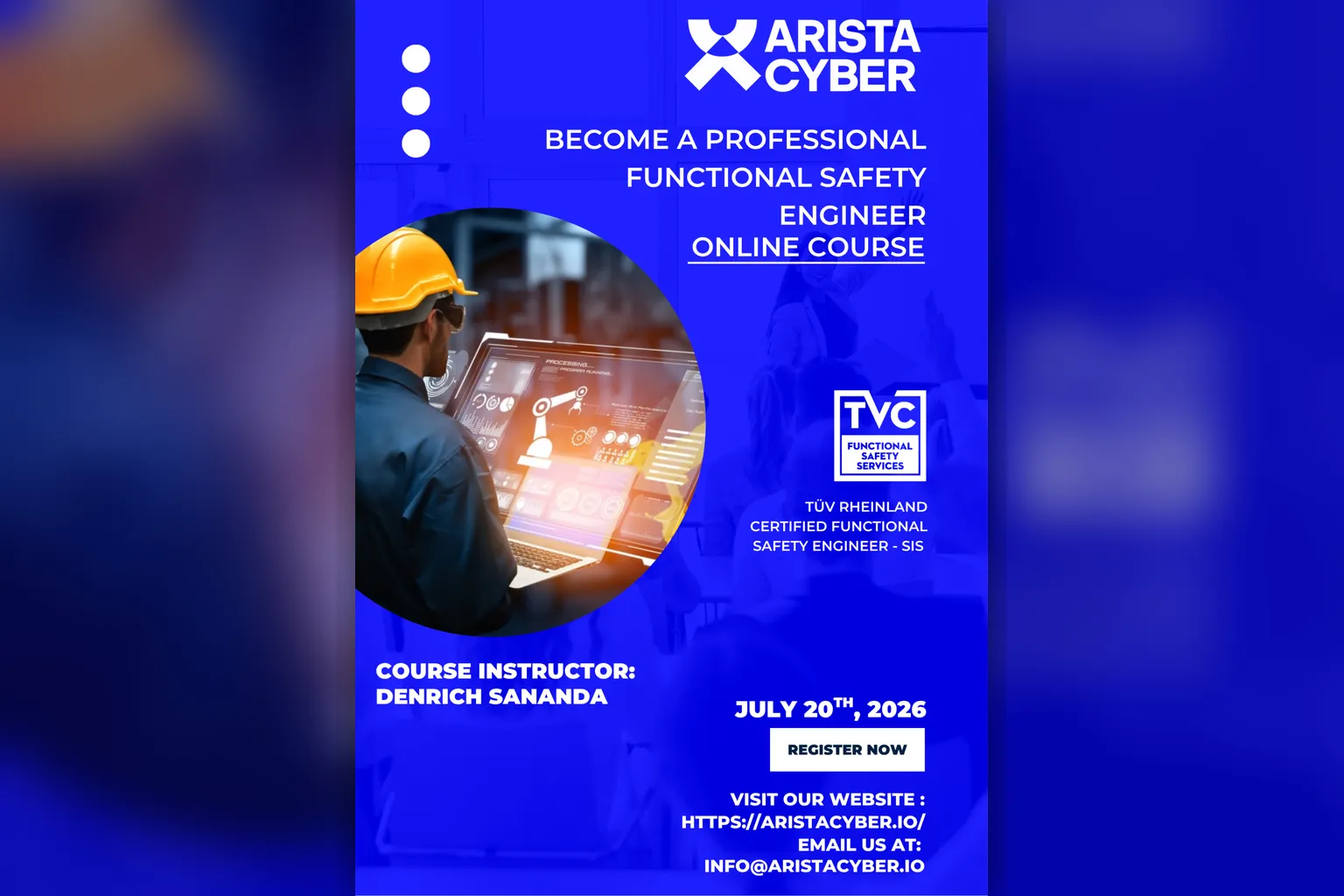
A structured, internationally recognized program for engineers and safety professionals who need verified competency across the full SIS lifecycle. Certification is issued directly by TÜV Rheinland.
|
Training Dates |
July 20-24, 2026 |
|---|---|
|
Format |
Fully online - training and exam conducted online |
|
Duration |
5 days: 3 days of instruction + 1 day self-study + 1 day exam |
|
Exam Date |
July 24, 2026 - 4 hours, 85 marks, monitored by TÜV Rheinland |
|
Language |
English |
|
Cohort Size |
Maximum 12 participants |
|
Certification |
FS Engineer (TÜV Rheinland) - personal certificate, listed on TÜV Rheinland's website |
|
Delivered by |
Arista Cyber, in partnership with TVC Functional Safety Services FZ-LLC |
|
|
|
Industrial environments run on safety. When a Safety Instrumented System fails - or is designed without proper rigor - the consequences extend well beyond downtime. This program was built for professionals who carry responsibility for SIS design, implementation, and oversight, and who need internationally validated credentials to back that responsibility.
The Functional Safety Engineer (TÜV Rheinland) certification confirms that participants have the technical knowledge and practical understanding to manage safety lifecycle activities in line with IEC 61508 and IEC 61511. Certification is issued by TÜV Rheinland and lists the certified professional on their global registry.
This July cohort is limited to 12 participants, keeping sessions focused and instructor interaction meaningful throughout the five days.
IEC 61511 Edition 2.0 does not treat functional safety competency as optional. It sets out three clear requirements that apply to every organization operating SIS in a regulated environment:
Earning this certification gives professionals a recognized, verifiable record of competency. For organizations, it directly supports compliance with IEC 61511's competency management requirements and strengthens credibility with clients, regulators, and auditors.
This program is suited to experienced professionals who work within or alongside the SIS lifecycle in any industrial sector:
Participants must have a minimum of 3 to 5 years of relevant experience in control and instrumentation, process engineering, IT/OT, functional safety, or cybersecurity, along with a university degree or equivalent experience certified by an employer or engineering institution. Eligibility documentation must be submitted and confirmed before the exam.
Participants leave this program with practical capability to:
Functional Safety Fundamentals Core safety principles, industrial incident analysis, IEC 61511 requirements, SIS and SIL concepts, and common failure modes in safety systems.
Functional Safety Management and Lifecycle Lifecycle governance under IEC 61508 and IEC 61511, competency management, risk assessment frameworks, audit processes, and SIS configuration control.
Safety System Planning and SRS Development Lifecycle planning frameworks, functional safety management systems, verification and validation planning, and end-to-end Safety Requirement Specification development.
Hazard and Risk Assessment FMEA, FTA, HAZOP, ETA, and ALARP methodologies, risk evaluation frameworks, and structured risk reduction approaches.
Security and Risk Integration Security risk assessment in functional safety contexts, digital system mapping, security and assurance levels, and foundational security requirements.
Safety Function Allocation (LOPA) Layer of Protection Analysis methodology, independent protection layers, safety integrity requirement determination, and applied LOPA exercises.
SIS Design, Engineering, and Implementation Hardware and software design principles, SIL architecture selection, diagnostics, proof testing, device selection, application program development, and functional acceptance testing (FAT and SAT).
Lifecycle Operations and Practical Application Operations, maintenance, modification, and decommissioning activities supported by hands-on exercises covering SIL selection, safety function design, and real-world case studies.
|
Day |
Date |
Focus |
|---|---|---|
|
Days 1, 2 & 3 |
July 20-22, 2026 |
Functional safety principles, lifecycle, hazard and risk assessment, SIL, SRS, SIS design, validation, and practical exercises |
|
Day 4 |
July 23, 2026 |
Self-study, review, and TÜV Rheinland exam preparation |
|
Day 5 |
July 24, 2026 |
TÜV Rheinland Examination: 4 hours, 85 marks |
The exam takes place on Day 5 and is monitored directly by TÜV Rheinland. All assessments are conducted online.
Participants who meet the passing threshold receive their personal FS Engineer (TÜV Rheinland) certificate and are listed on the TÜV Rheinland registry.
This program was designed by Tino Vande Capelle, a globally recognized Functional Safety Expert, and is delivered by Arista Cyber in partnership with TVC Functional Safety Services FZ-LLC.
Denrich Sananda | Lead Trainer
Denrich Sananda holds TÜV Rheinland certification as both a Functional Safety Engineer (ID 855/07) and Functional Safety Trainer (ID 77/22). With more than 24 years of experience across the process industry, he brings structured, standards-aligned instruction grounded in the realities of industrial environments.
What happens next:
Empower your workforce | Strengthen your defenses | Build trust
The person who completes this form will be responsible for the full payment and will receive all further communication.

